The world of manufacturing and material processing relies heavily on effective grinding techniques. Central to these techniques are the types of abrasives in grinding used, which dictate the precision, speed, and efficiency of the process. Understanding these different abrasive materials – from natural stones to synthetic compounds – is crucial for optimizing industrial operations, ensuring product quality, and driving innovation across diverse sectors. This knowledge is not merely academic; it has tangible implications for global economies, technological advancements, and sustainable practices.
The relevance of types of abrasives in grinding spans a vast spectrum of industries. From aerospace and automotive manufacturing to construction and medical device production, the ability to shape, refine, and polish materials with accuracy is paramount. The global abrasives market is a multi-billion dollar industry, projected to continue its growth trajectory fueled by increasing demand for precision engineering, advanced materials, and stricter quality control standards. Data from the ISO indicates that abrasive material standards are constantly evolving, reflecting the industry’s commitment to performance and safety.
Ultimately, mastering the selection and application of types of abrasives in grinding translates into tangible benefits for businesses and society. It enables the creation of higher-quality products, reduces material waste, lowers production costs, and enhances workplace safety. In a world increasingly focused on efficiency and sustainability, a deep understanding of abrasive technology is no longer a competitive advantage—it’s a necessity.
The Fundamentals of types of abrasives in grinding
At its core, grinding is a material removal process that uses abrasive particles to wear away unwanted material from a workpiece. The effectiveness of this process hinges on the properties of the types of abrasives in grinding used. These abrasives are categorized by their material composition, hardness, grit size, and bonding method, each influencing the resulting surface finish, material removal rate, and overall efficiency.
The choice of abrasive isn’t arbitrary. It’s dictated by the workpiece material, the desired outcome (roughing, finishing, polishing), and the grinding method employed (surface grinding, cylindrical grinding, etc.). A thorough understanding of these interdependencies is essential for any engineer or technician involved in manufacturing or materials processing.
Categorizing Abrasive Materials
Types of abrasives in grinding fall broadly into two categories: natural and synthetic. Natural abrasives, like diamond, corundum, and garnet, have been used for centuries due to their inherent hardness and cutting ability. However, their inconsistent quality and limited availability have led to the widespread adoption of synthetic abrasives.
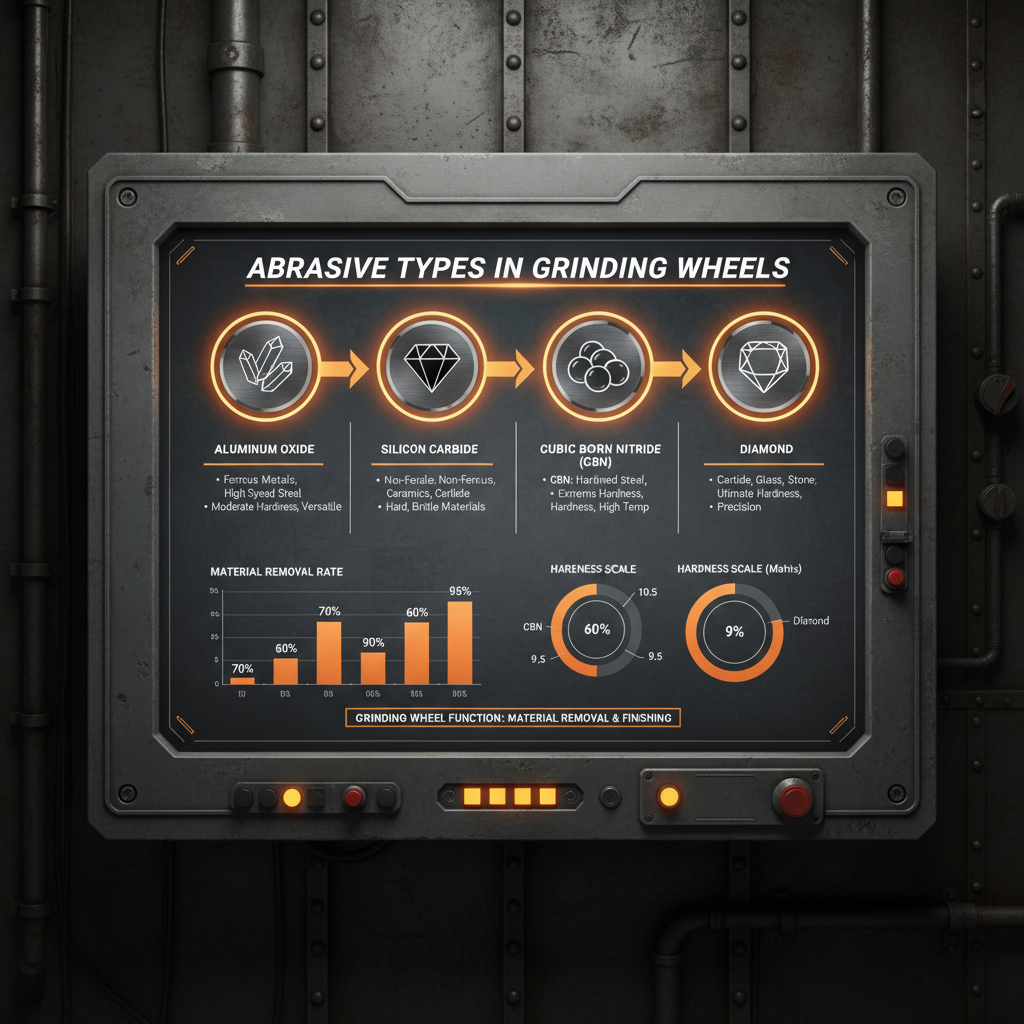
Synthetic abrasives, such as aluminum oxide, silicon carbide, and cubic boron nitride, offer superior control over purity, grain size, and crystal structure. This translates to more predictable and consistent grinding performance. Aluminum oxide is the most commonly used abrasive, valued for its versatility and cost-effectiveness, while silicon carbide excels in grinding hard and brittle materials. Cubic boron nitride is reserved for extremely hard materials, like hardened steel.
The bonding material used to hold the abrasive grains together is also critical. Common bonding agents include vitrified bonds (ceramic), resin bonds (organic), and metal bonds. Each bond type offers different characteristics in terms of strength, porosity, and heat resistance, impacting the abrasive wheel’s lifespan and performance.
Factors Influencing Abrasive Performance
Several key factors dictate the effectiveness of types of abrasives in grinding. Hardness, measured using the Mohs scale or Vickers hardness test, is a fundamental property determining the abrasive's ability to cut other materials. Grit size, referring to the average diameter of the abrasive particles, affects the surface finish – coarser grits remove material rapidly but leave a rougher surface, while finer grits produce a smoother, more polished finish.
Friability, or the tendency of the abrasive grains to fracture during grinding, influences the rate of self-sharpening. Highly friable abrasives wear away more quickly, exposing fresh cutting edges, while less friable abrasives maintain their shape longer but may become dull more rapidly. Finally, the abrasive’s toughness, or its resistance to fracture under impact, is crucial for demanding applications.
Understanding the interplay between these properties is essential for selecting the optimal abrasive for a specific grinding task. For example, a brittle abrasive might be ideal for a high-speed grinding operation, while a tough abrasive would be more suitable for heavy-duty stock removal.
Applications Across Industries
The application of types of abrasives in grinding is incredibly diverse. In the aerospace industry, precision grinding is used to manufacture turbine blades and engine components from superalloys. The automotive sector relies on abrasive grinding for shaping cast iron brake rotors and finishing engine blocks.
In the medical device industry, extremely precise grinding is required for creating surgical instruments and implants from biocompatible materials. The construction industry utilizes abrasive wheels for cutting and grinding concrete, stone, and asphalt. The tooling industry depends on abrasives for sharpening cutting tools, ensuring their efficiency and longevity.
Even in seemingly unrelated fields like electronics, abrasive grinding is used to create flat surfaces on silicon wafers, which are fundamental to semiconductor manufacturing. Each industry demands specific abrasive characteristics tailored to the materials being processed and the required precision levels.
Grinding Performance Comparison of Abrasive Types
Advantages and Economic Impact
The correct application of types of abrasives in grinding delivers significant advantages. These include reduced production times due to faster material removal rates, improved surface finishes leading to enhanced product quality, and lower overall manufacturing costs through minimized material waste and tool changes.
Economically, the abrasive industry contributes substantially to global manufacturing output. The development and refinement of new abrasive materials and technologies drive innovation, creating high-skilled jobs and fostering economic growth. Furthermore, efficient grinding processes translate to reduced energy consumption and a smaller environmental footprint.
Emerging Trends in Abrasive Technology
Several key trends are shaping the future of abrasive technology. One prominent development is the rise of superabrasives, such as polycrystalline diamond (PCD) and chemical vapor deposition (CVD) diamond, offering exceptional hardness and wear resistance. Another trend is the increasing use of nano-abrasives, which possess enhanced cutting performance due to their extremely small particle size.
Furthermore, advancements in bonding technology are leading to the creation of more durable and efficient abrasive wheels. The integration of sensors and data analytics into grinding machines is enabling real-time monitoring and optimization of grinding processes, resulting in improved control and reduced downtime.
Challenges and Future Directions
Despite significant advancements, challenges remain in the field of types of abrasives in grinding. One major issue is the generation of dust and debris during grinding, posing health and safety risks. Another challenge is the high cost of some advanced abrasive materials, limiting their widespread adoption.
Future research efforts will focus on developing more environmentally friendly abrasives, reducing dust generation, and lowering production costs. The development of self-sharpening abrasives and adaptive grinding systems that automatically adjust to changing workpiece conditions are also promising areas of investigation.
Ultimately, the ongoing pursuit of innovation in abrasive technology will continue to drive improvements in manufacturing efficiency, product quality, and sustainability.
Summary of Abrasive Performance Characteristics
| Abrasive Type |
Hardness (Mohs Scale) |
Typical Application |
Cost (Relative) |
| Aluminum Oxide |
9 |
General purpose grinding, steel, wood |
Low |
| Silicon Carbide |
9.5 |
Grinding hard materials, ceramics, non-ferrous metals |
Medium |
| Cubic Boron Nitride |
10 |
Grinding hardened steel, superalloys |
High |
| Diamond |
10 |
Grinding extremely hard materials, precision polishing |
Very High |
| Garnet |
7.5 |
Wood, leather, polishing |
Low |
| Ceramic Abrasive |
9.5 |
High-performance grinding, precision finishing |
Medium-High |
FAQS
Bonded abrasives, like grinding wheels, use a bonding agent to hold abrasive particles together in a specific shape. They're used for aggressive material removal. Coated abrasives, such as sandpaper, have abrasive grains adhered to a backing material. They’re used for finishing, polishing, and lighter stock removal. The choice depends on the application’s specific needs—volume of material removal, surface finish, and geometry.
Grit size is crucial. Coarser grits (lower numbers) remove material quickly but leave a rough finish, ideal for initial stock removal. Finer grits (higher numbers) provide a smoother finish, perfect for polishing or precision work. Start with a coarser grit to remove material, then progressively use finer grits to achieve the desired surface quality. Consider the material being ground and the desired level of precision.
Superabrasives, like diamond and cubic boron nitride (CBN), are exceptionally hard materials used for grinding very hard or abrasive workpieces. Diamond is best for non-ferrous materials and CBN for hardened steel. They're considerably more expensive than conventional abrasives, making them suitable for applications where high precision, long tool life, and efficient material removal are critical, such as aerospace and tool manufacturing.
The bonding agent holds the abrasive grains together and influences wheel hardness, porosity, and strength. Vitrified bonds are common for general-purpose grinding, offering good strength and heat resistance. Resin bonds are flexible and used for cutting applications. Metal bonds are strong and porous, suitable for high stock removal. The appropriate bond type depends on the abrasive grain, workpiece material, and grinding conditions.
Grinding generates sparks, dust, and noise. Always wear safety glasses or a face shield, hearing protection, and a dust mask or respirator. Ensure proper ventilation to remove airborne particles. Use machine guards and follow all manufacturer’s safety instructions. Inspect grinding wheels for cracks or damage before use. Never exceed the wheel’s maximum operating speed.
Proper dressing and truing are crucial for extending wheel life. Dressing removes dull abrasive particles and opens up new cutting edges. Truing restores the wheel’s geometric accuracy. Avoid excessive grinding pressure and use the correct grinding speed. Regularly inspect the wheel for wear and damage, and replace it when necessary. Correct coolant application also helps reduce heat and wear.
Conclusion
Understanding the types of abrasives in grinding is paramount for optimizing industrial processes, enhancing product quality, and driving innovation. From the fundamental properties of hardness and grit size to the advanced applications of superabrasives and emerging technologies, a comprehensive knowledge of abrasive materials is essential for success in manufacturing, engineering, and beyond. Choosing the right abrasive isn’t simply about removing material; it's about achieving precision, efficiency, and sustainability.
Looking ahead, continued research and development in abrasive technology will focus on creating more environmentally friendly materials, reducing dust generation, and enhancing grinding performance. By embracing these advancements, industries can unlock new levels of productivity, reduce costs, and minimize their environmental footprint. Visit our website at www.cutoffdiscs.com to explore our range of abrasive solutions and learn how we can help you achieve your grinding goals.